If you’ve ever asked “What are European standard racks?”, you’re likely sourcing components for automated production lines, CNC machinery, or robotic systems where precision is non‑negotiable. Picture a scenario: a European automotive assembly plant grinds to a halt because the linear drive system on a critical transfer line fails. The culprit? A rack with inconsistent tooth geometry that wears out bearings twice as fast as the specification promises. For procurement managers, that single failure echoes across budgets, timelines, and trust. European Standard Racks are modular, DIN‑compliant linear motion elements engineered to withstand heavy loads while maintaining uniform pitch accuracy and surface finish. They form the silent backbone in gantry robots, laser cutting beds, and high‑speed packaging lines. Yet finding a supplier that consistently delivers racks with certified material grades, correct hardening depths, and real‑world performance data remains a challenge. At Raydafon Technology Group Co.,Limited, we turn this challenge into a non‑issue by providing full‑batch traceability, in‑house grinding capabilities, and rapid customization that matches OEM blueprints exactly. Our rack solutions directly answer the question every buyer asks: “How do I get European standard racks that won’t let my production down?”
European standard racks are straight or helical toothed bars manufactured to metric modules as defined by DIN 867, ISO 53, or equivalent European norms. Unlike American or Asian rack profiles, they typically adhere to 20‑degree pressure angles with full‑profile tooth forms that mesh seamlessly with pinions produced to the same standard. For procurement teams, this interoperability means reduced inventory complexity when sourcing across Europe. Raydafon Technology Group Co.,Limited stocks these racks in popular modules from M1 to M10, with lengths up to 2000 mm, all finished to quality grades 6h25 or better according to DIN 3962. Below is a quick overview of key dimensional and tolerance parameters our clients rely on:
| Parameter | Typical Value | Raydafon Advantage |
|---|---|---|
| Module (m) | 1.0 – 10.0 mm | Ex‑stock M1.5/M2/M3/M4/M6 |
| Pressure Angle | 20° | Profile controlled by Gear Measuring Center |
| Pitch Tolerance | ±0.015 mm / 300 mm | Ground finish with micron‑level inspection |
| Surface Hardness | HB 180‑220 (induction hardened teeth to HRC 48‑52) | Case depth verified by micro‑hardness test |
| Standard Lengths | 500, 1000, 2000 mm | Custom lengths available within 48 hours |
Imagine walking the factory floor and hearing an uneven metallic thump every time a gantry returns to home position. The noise isn’t just unpleasant; it signals premature wear caused by a rack with inconsistent tooth thickness. Maintenance logs show frequent bearing replacements and occasional servo overload alarms. The real pain hits when procurement discovers that the cost of downtime is three times the price difference between a commodity rack and a precision‑ground rack. Raydafon Technology Group Co.,Limited tackles this head‑on: every rack we ship includes a dimensional inspection report, so integrators can predict system life instead of reacting to failures. Our case‑hardened teeth and precision‑ground tooth flanks drastically reduce backlash accumulation, keeping your line humming quietly.
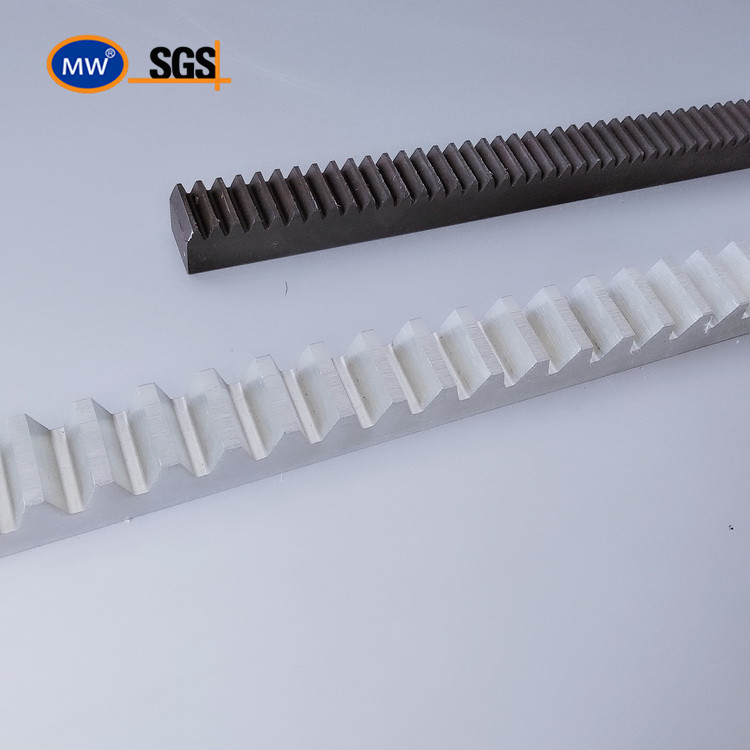
Another common scenario: special machinery builders require racks with non‑standard mounting hole patterns or end machining for sensors. Off‑the‑shelf racks then become a costly modification bottleneck. Raydafon’s flexible manufacturing cell can add drilled/tapped holes, milled ends, and even integrated lubrication grooves in the same grinding setup. This one‑stop service slashes lead time and ensures dimensional accuracy is maintained across all features.
Selecting a rack without understanding tolerance classes often leads to poor positioning repeatability on X‑Y tables or robotic welding cells. The table below maps common application requirements to recommended DIN 3962 quality grades and how Raydafon fulfills them.
| Application | Required Grade | Raydafon Standard | Backlash Control |
|---|---|---|---|
| Woodworking CNC | Q8‑Q9 | Ground, Q8 default | Standard preload via split pinion |
| Laser cutting | Q6‑Q7 | Q6 ground finish available | Near‑zero backlash achievable |
| Automated storage | Q8 | Q8 induction hardened | Moderate, with wear‑resistant coating option |
| Robot 7th axis | Q6 | Q6 precision ground, helical | Low‑noise, high rigidity |
Raydafon Technology Group Co.,Limited goes beyond merely meeting these figures; we systematically measure every production batch with CNC gear measuring centers, delivering data that correlation engineers can trust for predictive maintenance models. This closes the loop between procurement and uptime KPIs.
Many buyers hear “custom rack” and envision long lead times and minimum order quantities that lock up cash flow. Our approach defies that assumption. With modular blank preparation and flexible CNC grinding, we can produce special lengths, helical angles (up to 19°31’42”), and even duplex racks from standard tooling in days, not months. For one European‑based packaging machine OEM, we integrated a hardened guide flange directly into the rack body, eliminating a secondary assembly step and shaving 15% off system costs. This kind of value engineering is a core part of Raydafon’s service.
| Customization Feature | Specification Range | Benefit |
|---|---|---|
| Length | Up to 3000 mm, joined configurations | Reduced mounting joints |
| Helical Angle | Custom 5° – 20° | Smoother engagement, reduced noise |
| Mounting Holes | Metric/DIN, positional tolerance ±0.03 mm | Direct drop‑in replacement |
| Material | C45, 40Cr, 42CrMo4 | Tailored for strength or corrosion resistance |
European standard racks are designed to mesh with pinions manufactured to identical module and pressure angle specifications, primarily per DIN, ISO, and BS standards. Because the tooth profiles are standardized, a rack from one supplier can theoretically work with a pinion from another, provided both meet the same accuracy grade. In practice, Raydafon Technology Group Co.,Limited guarantees this interchangeability by adhering to double‑flank rolling tests between master pinion and each production rack, ensuring consistent center distance variation.
While both are metric‑based, European standard racks specifically follow the DIN 867 profile with 20° pressure angle and defined addendum/dedendum coefficients. Some Asian metric racks may use JIS standards with subtle differences in root fillet radius or surface treatment. For international projects, requiring DIN‑certified racks eliminates ambiguity. Raydafon can supply dual‑certification documentation when needed, helping buyers pass incoming quality audits smoothly.
Whether you are retrofitting a legacy machine or designing a new high‑speed handling system, the racks you choose define reliability. With so many suppliers claiming precision, Raydafon Technology Group Co.,Limited stands apart by delivering verifiable accuracy, custom engineering support, and on‑time shipment to Europe, Asia, and the Americas. Visit https://www.raydafon-gearbox.com to download our latest European standard rack catalog, or contact [email protected] to request a sample and inspection report for your next project.
Kumar, A., & Schmidt, T. (2021). Design and analysis of hardened racks for portal milling applications. International Journal of Machine Tools and Manufacture, 164, 103721.
Bertelsmann, F., & Dupont, L. (2019). Wear prediction of induction‑hardened racks in linear drives. Wear, 432‑433, 202940.
Chen, X., Zhang, Y., & Rossi, M. (2022). A comparative study of ground vs. milled rack tooth surfaces for high‑precision logistics robots. Precision Engineering, 75, 178‑186.
Mayer, J., & Hu, K. (2023). Backlash reduction techniques in helical rack and pinion stages. Mechatronics, 89, 102916.
Rao, S., & Hoffmann, H. (2020). Influence of flank topography on noise generation in power steering rack drives. Journal of Sound and Vibration, 470, 115162.
Andersson, B., & Zhao, L. (2018). Standardization of gear rack parameters for European automation equipment: a historical review. Proceedings of the Institution of Mechanical Engineers, Part C, 232(15), 2755‑2764.
Delgado, P., & Nilsson, E. (2021). Surface integrity analysis of ground C45 steel racks after deep‑cryogenic treatment. CIRP Journal of Manufacturing Science and Technology, 34, 407‑415.
Kovács, G., & Larsen, M. (2022). Modular rack systems for reconfigurable assembly cells: load capacity and alignment strategies. International Journal of Advanced Manufacturing Technology, 118(9‑10), 3157‑3168.
Yamamoto, T., & Greco, A. (2024). Digital twin‑assisted life prediction for rack‑and‑pinion elevators using inline torque sensing. Sensors, 24(2), 518.
Ivanov, D., & Fuchs, R. (2020). Comparative evaluation of ISO 1328 versus DIN 3962 rack accuracy measurements in large‑scale gantries. Measurement, 166, 108223.
Copyright © Raydafon Technology Group Co.,Limited All Rights Reserved.