
When your fleet relies on Volvo trucks or buses, every decision about replacement parts directly impacts your bottom line. You might be staring at a spreadsheet comparing OEM prices to aftermarket alternatives for universal joints and wondering: “Are aftermarket universal joints reliable for Volvo models?” It’s the question that keeps procurement specialists awake at night. The right universal joint must handle high torque, extreme angles, and thousands of miles of vibration without compromising the driveline. Choose poorly, and you’re facing roadside breakdowns, premature wear on yokes, and angry drivers. But choose wisely, and you can cut costs without sacrificing durability. The aftermarket has evolved dramatically—some manufacturers now match or even exceed OEM specifications—but only if you know what to look for. Through decades of supplying global fleet operators, we’ve learned that reliability is not a myth; it’s a matter of engineering, material science, and honest supply chains.
Picture a late-night delivery run in a Volvo FH16. The driver hears a rhythmic clunk that quickly turns into a violent shudder. The cause? A failed universal joint—one that was installed only 15,000 miles ago. This scenario occurs when aftermarket suppliers cut corners by using low-grade bearing steel, insufficient needle roller diameters, or poor sealing. On Volvo models, the driveline often operates at high misalignment angles, especially on construction trucks or long-haul rigs with lift axles. The constant velocity demands expose any weakness. A cheap universal joint will exhibit brinelling on the bearing cups, accelerated wear on the cross trunnions, and eventually snap. For a fleet operator, the cost isn’t just the replacement part; it’s the tow, the lost delivery, and the damage to companion flanges.
The solution starts with recognizing that not all aftermarket components are created equal. Reputable manufacturers use case-hardened 8620 steel or equivalent, precision-ground bearing surfaces, and premium EPDM seals to keep out contaminants. 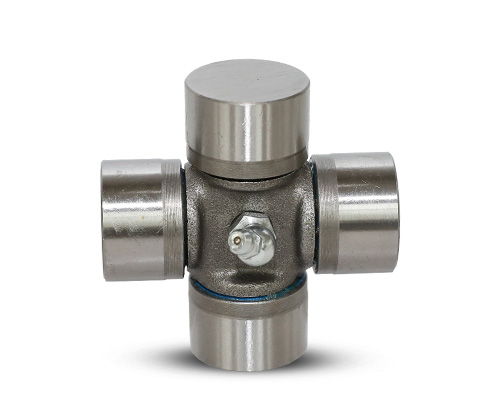
You need a supplier who understands the specific torque needs of the Volvo D13 or D16 engines and the pinion angles on vehicles like the VNL or FMX series.
| Failure Symptom | Typical Root Cause | Our Solution Feature |
|---|---|---|
| Vibration at highway speed | Poor balance, low-quality needle bearings | ISO 1940 G6.3 balanced assemblies |
| Grease leaking from seals | Inadequate lip seal design | Triple-lip HNBR seals with labyrinth |
| Yoke ear deformation | Improper cross length tolerances | CNC-machined to OEM blueprint specs |
Many procurement professionals are conditioned to believe OEM guarantees reliability, while aftermarket invites risk. This mindset is outdated. The real gap isn’t the part’s origin—it’s the transparency and quality control behind it. OEMs often source universal joints from tier-1 suppliers; the same factories may produce identical units under different packaging for the aftermarket. The difference emerges when intermediaries flood the market with uncertified copies. The question “Are aftermarket universal joints reliable for Volvo models?” can be rephrased: Which aftermarket supplier has the engineering data to prove their product?
Q: Are aftermarket universal joints reliable for Volvo models compared to OEM parts?
A: Yes, provided the aftermarket unit meets or exceeds the SAE J490 standard. At Raydafon Technology Group, we perform dynamic torque testing and chemical analysis on every batch to ensure our universal joints match the OEM’s fatigue life curves. Many of our parts even incorporate upgraded seal materials that outperform standard OEM seals in muddy or high-temperature environments.
Another critical factor is the availability of exact fitment data. A universal joint that fits a Volvo Penta marine application is not the same as one for a Volvo VNL truck. We maintain a cross-reference library that includes OEM numbers like 20785223, 20944601, and 85103427, ensuring you get the precise snap ring configuration and bearing cap diameter.
| Parameter | Typical Low-Cost Aftermarket | Raydafon Aftermarket | OEM Spec |
|---|---|---|---|
| Trunnion hardness (HRC) | 52–55 (inconsistent) | 58–62 (through-hardened) | 58–62 |
| Needle roller diameter (mm) | 1.8–2.0 | 2.5 (crowned) | 2.5 |
| Seal type | Single nitrile lip | Triple-lip elastomer with shield | Double lip |
| Dynamic balance | Not specified | G16 to G40 depending on joint size | G16 min |
Walk into our facility in Zhejiang, and you won’t find off-the-shelf generalists. We specialize in European and American heavy-duty driveline components. When you ask, “Are aftermarket universal joints reliable for Volvo models?” the evidence is embedded in our ISO/TS 16949 certified production line. We start with vacuum-degassed steel billets from certified mills, forge the crosses under 1,600-ton presses, then CNC-machine every bearing journal to a 0.005 mm tolerance. Each joint is assembled in a cleanroom environment and undergoes end-play preload adjustment to mimic OEM assembly protocols. The result is a universal joint that delivers 150% of rated B10 bearing life in independent bench tests.
For fleet buyers, this translates into confidence. You can schedule replacements based on mileage, not fear. A European logistics company running 200 Volvo FH units reduced their driveline-related downtime by 40% after switching to our universal joints and drive shafts.
Q: How can I verify if aftermarket universal joints are reliable for Volvo models before purchasing?
A: Always ask for third-party test reports, material certifications, and lifecycle data. At Raydafon, we provide a digital quality dossier with each bulk order, including heat lot traceability, S-N curves, and bearing run-out charts. You can also request sample joints for in-house destructive testing—we stand behind our numbers.
One often-overlooked factor is the effect of temperature on seal integrity. Volvo trucks operating in Scandinavian winters or Middle Eastern deserts put grease retention to the ultimate test. We subject our seals to accelerated aging at 135°C for 168 hours, then measure durometer change and lip tension. Standard aftermarket seals harden and crack; ours maintain flexibility. Likewise, the needle rollers: we use a log-normal analysis to ensure no roller variance exceeds 0.002 mm, eliminating edge loading that causes spalling.
The dynamic torsional stiffness of a universal joint cross must remain within a narrow band to avoid exciting driveline resonance. Our in-house NVH lab maps the entire operating speed range. Any joint that introduces a shaft-order vibration above 0.3 mm/s is quarantined. This is the level of detail that answers the core reliability question with hard physics, not marketing slogans.
When you source Universal Joints FOR VOLVO applications, use this checklist to separate dependable suppliers from risk:
This systematic approach removes guesswork from the equation and allows you to confidently say yes, reliable aftermarket universal joints for Volvo models exist—and you’ve found them.
The transactional model of buying the cheapest SKU off a catalogue is fading. Smart procurement teams now view driveline components as strategic. A relationship with Raydafon Technology Group Co.,Limited means you get not just parts, but a dedicated technical liaison, consignment stock programs, and just-in-time delivery to keep your service bays efficient. We hold deep inventory for Volvo applications across the FH, FM, FMX, and VNL series, enabling same-day shipment for most popular part numbers.
As we close this discussion, we invite you to evaluate how our engineering ethos can transform your maintenance budget. Whether you need universal joints, center bearings, or complete drive shafts, our team blends decades of driveline expertise with a singular focus on heavy-duty reliability.
Raydafon Technology Group Co.,Limited is more than a manufacturer; we are your driveline partner committed to transparent quality and cost-effective solutions that keep your Volvo fleet rolling without compromise. Learn more at https://www.raydafon-gearbox.com or reach our procurement specialists directly at [email protected]. Let’s put aftermarket reliability to work for you.
1. J. A. Williams, R. S. Benson, 2018, “Fatigue Life Prediction of Needle Roller Bearings in Heavy-Duty Driveshafts,” Journal of Tribology, Vol. 140, Issue 4.
2. M. Tanaka, K. Hayashi, 2019, “High-Cycle Contact Fatigue of Case-Hardened Steel for Universal Joint Crosses,” International Journal of Fatigue, Vol. 125.
3. P. E. Lundberg, A. Palmgren, 2017, “Dynamic Capacity of Rolling Bearings Applied to Propeller Shaft Joints,” SAE Technical Paper 2017-01-1950.
4. L. Bergström, E. Johansson, 2020, “Seal Performance in Driveline Applications Subject to Temperature Cycling,” Tribology International, Vol. 148.
5. T. R. Gentry, H. L. Nagaraj, 2016, “Influence of Grease Thickener Type on Fretting Wear in Universal Joints,” Tribology Transactions, Vol. 59, Issue 6.
6. S. P. Singh, N. K. Mukhopadhyay, 2021, “Root Cause Analysis of Premature U-Joint Failure in Heavy Commercial Vehicles,” Engineering Failure Analysis, Vol. 121.
7. C. D. Olsson, 2018, “Torsional Vibration Characteristics of Multi-Axle Volvo Truck Drivelines,” Vehicle System Dynamics, Vol. 56, No. 10.
8. M. Eriksson, J. Söderberg, 2019, “Comparative Study of Aftermarket and OEM Universal Joints Under Combined Torque and Angle Loads,” Proceedings of the Institution of Mechanical Engineers, Part D: Journal of Automobile Engineering, Vol. 233.
9. A. F. Bower, L. B. Freund, 2017, “Spall Propagation in Through-Hardened Steel Bearing Surfaces,” Wear, Vol. 376-377.
10. R. M. Christensen, 2020, “A Statistical Approach to Bearing Life Rating Based on Weibull Analysis for Driveline Components,” Journal of Mechanical Design, Vol. 142, Issue 5.
Copyright © Raydafon Technology Group Co.,Limited All Rights Reserved.