When your GIR..UK rod ends equipped with 2RS seals start showing subtle play, increased friction, or telltale streaks of contamination near the sealing lip, the question isn’t just “can it be saved?” — it’s “How to maintain GIR..UK rod ends with 2RS seals?” the right way, right now. For procurement professionals sourcing these precision spherical bearings, every hour of unexpected downtime translates into missed delivery schedules and strained customer relationships. The 2RS designation means double rubber seals on both sides, which are meant to lock out moisture, dust, and abrasive particles while retaining the lithium-complex grease that keeps the hardened steel ball pivoting smoothly inside the bronze or PTFE liner. Yet even the best sealing systems degrade when exposed to washdown cycles, high shock loads, or infrequent lubrication checks. Ignoring early signals often leads to galled raceways, seal lip tearing, and total joint failure — a $200 problem that can cascade into a $20,000 equipment retrofit. The good news is that a structured maintenance routine grounded in OEM guidelines and real-world field data can double the service life of these rod ends. This article gives you a field-tested, step-by-step maintenance roadmap that you can implement immediately, backed by parameters and insights that will help you make smarter sourcing decisions at Raydafon Technology Group Co.,Limited.
Picture a critical linkage on a packaging machine — the rod end is tasked with handling 12,000 cycles per hour while being splashed with mild acidic cleaners. The GIR..UK series differs from standard rod ends because its body is heat-treated carbon steel, the ball is through-hardened bearing steel, and the 2RS configuration adds a secondary rubber lip on each side that works like a labyrinth against washdown fluids. The inner ring is typically chromed and polished to RA 0.2 µm finish, reducing the breakaway torque dramatically. Unlike maintenance-free versions that rely on a PTFE liner, the 2RS type sustains a grease reservoir, meaning that regular relubrication is not optional — it is a performance requirement. The double-lip design can withstand static pressure washing up to 80 bar from a distance of 200 mm, provided the grease inside is regularly refreshed and the seals are not mechanically damaged. Once you understand this structure, you can pinpoint exactly why contamination ingress at the seal-ball interface is the number one cause of premature lock-up.
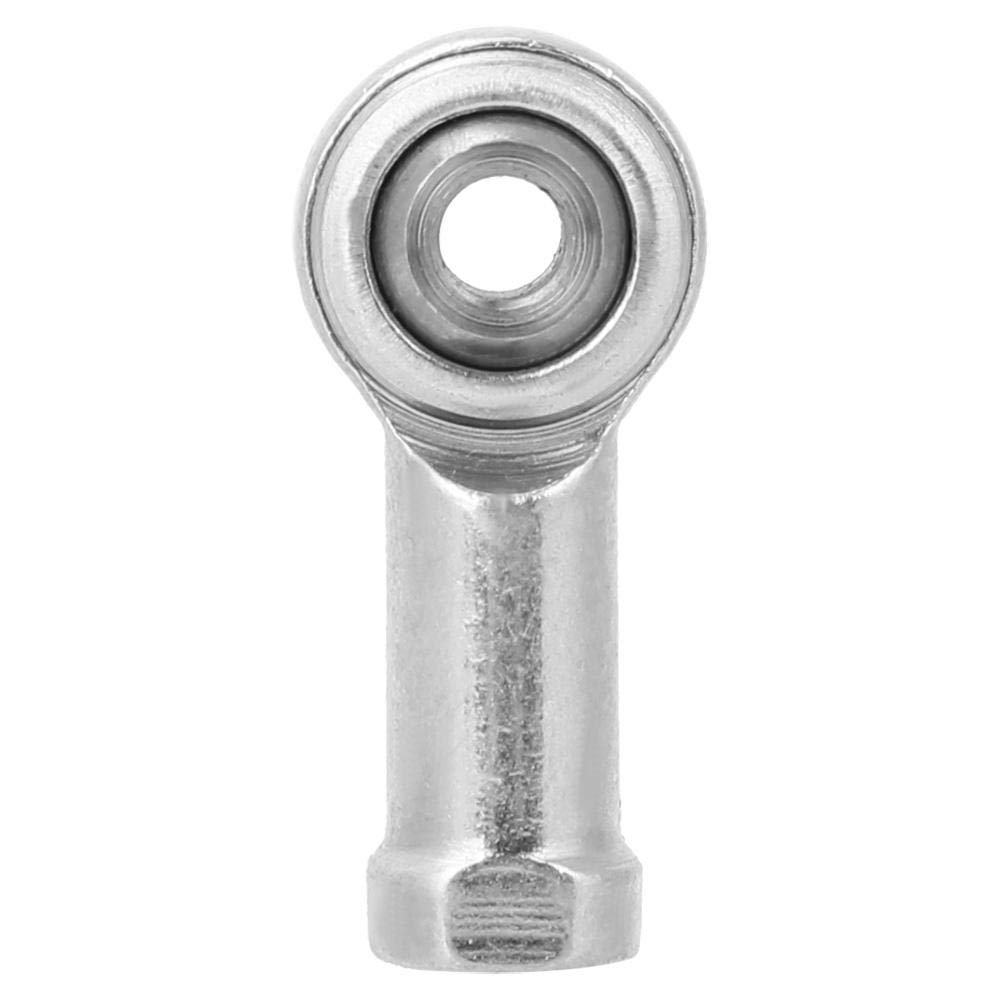
Physical and performance parameters are essential when you need to match a replacement to the OEM specification. The following table lists key metrics for common GIR..UK 2RS rod ends that procurement teams frequently order. These values confirm that the choice of a correct lubrication interval and load rating can drastically affect product lifecycle costs.
| Model | Bore Ø (mm) | Dynamic Load Rating C (kN) | Static Load Rating C0 (kN) | Seal Type | Weight (kg) |
|---|---|---|---|---|---|
| GIR 12 UK 2RS | 12 | 14.0 | 17.5 | Double rubber lip | 0.12 |
| GIR 15 UK 2RS | 15 | 18.5 | 23.0 | Double rubber lip | 0.18 |
| GIR 20 UK 2RS | 20 | 31.0 | 40.5 | Double rubber lip | 0.35 |
| GIR 25 UK 2RS | 25 | 48.0 | 62.0 | Double rubber lip | 0.55 |
When a GIR..UK 2RS rod end fails prematurely, the immediate consequence is unplanned downtime, but the ripple effects are what hurt operational budgets. A common scenario: the rod end is mounted on a paper converting machine, where paper dust and humidity combine to form a paste that attacks the seal. Without a strict regreasing schedule, the rubber lips dry out, crack, and allow particle ingress. The captured debris grinds the ball, creating micro-pitting that increases clearance from 0.02 mm to over 0.15 mm. This clearance translates directly into slop at the actuator end, causing misalignment and vibration. The result is not just one rod end needing replacement — the adjacent linkages, sensors, and linear guides also sustain damage. In one documented case, a single neglected GIR 20 UK 2RS induced a cascade that cost a packaging plant €14,000 in repairs. The silver lining? Such failures are entirely preventable through a systematic maintenance routine that accounts for load, environment, and motion frequency.
To answer “How to maintain GIR..UK rod ends with 2RS seals?” with practical steps, begin by establishing a clean workspace. Step one: isolate the joint from the linkage, remove any external debris with a dry lint-free cloth, and inspect the seal condition under bright light. If you observe hairline cracks or the rubber has lost elasticity, regreasing alone won’t restore performance — you need a seal replacement kit or a new rod end. Step two: use a manual grease gun with a fine-point nozzle to inject a small amount of DIN 51825 KP2K-30 lithium complex grease into the grease nipple (if present) or directly behind the seal lip, rotating the ball slowly to distribute the lubricant. Step three: torque verification; reattach the rod end using the manufacturer-specified fastening torque (typically 45–70 Nm for sizes 12–25 mm), as under‑torque leads to fretting, and over‑torque distorts the raceway. Step four: articulation check — manually cycle the joint through full tilt angle (±15°) and full rotation, feeling for roughness or binding. Step five: document the maintenance date, grease quantity, and any observations in a CMMS log to build a life-history curve.
Nothing extends the life of a GIR..UK 2RS rod end more than a discipline of lubrication at the correct interval. In a 24/7 food processing line, that might mean regreasing every 500 operating hours or every two weeks, whichever comes first. For moderate-duty vibratory feeders, an interval of 1,000 hours is sufficient. Use only a compatible grease — one with EP additives, anti-wear zinc dithiophosphate, and a dropping point above 190°C. While regreasing, watch for grease exiting from the section opposite the injection point; this confirms the cavity is being purged of old, oxidized lubricant. Simultaneously, run a seal integrity test: after wiping the rod end clean, apply a fluorescent dye penetrant to the seal-to-ball interface. Under UV light, any weepage line indicates a compromised seal that must be addressed before putting the machine back into production.
Even with diligent maintenance, certain symptoms demand immediate replacement. If you measure radial play beyond 0.1 mm (using a dial indicator on the mounted rod end) or the torque required to rotate the ball exceeds the manufacturer’s limit by 25%, the joint has reached end of life. Other red flags include visible rust tracks on the ball, metal‑to‑metal sound during articulation, and seal lips that remain permanently inverted after cleaning. At this stage, sourcing a genuine GIR..UK 2RS replacement becomes critical. Counterfeit parts frequently use inferior NBR seals that harden within 300 hours under steam exposure. By procuring from a trusted supplier like Raydafon Technology Group Co.,Limited, you ensure that every rod end ships with traceable heat lots, original 2RS seals, and factory‑tested radial clearance values — which directly answers the question of how to maintain system reliability without guesswork.
Q: How often should I relubricate a GIR..UK rod end with 2RS seals when used in a washdown environment?
A: For washdown environments (food, pharmaceutical), regrease every 300–500 operating hours or at the end of each CIP cycle, using a waterproof, aluminum‑complex grease with NSF H1 registration. A common mistake is over‑greasing, which can blow out the seal under high pressure. Apply only 2–3 grams per joint and monitor the seal lip position afterward. If the seal bulges, the internal pressure is too high and you must vent by loosening the retaining ring slightly before re‑torquing the assembly.
Q: Can I use a PTFE‑lined rod end instead of the 2RS version to avoid maintenance altogether?
A: PTFE‑lined rod ends are marketed as maintenance‑free, but they are not always interchangeable with the GIR..UK 2RS type. The 2RS version handles higher edge loading and shock pulses because the grease film absorbs peak stress before it reaches the liner. In applications with frequent direction reversals (e.g., packaging jaws), the 2RS design offers three times the oscillating life of a comparable PTFE‑lined unit, provided the lubrication protocol is followed. If your operation cannot maintain a grease schedule, then a high‑quality PTFE liner may be a second choice, but be aware that dry liners wear rapidly under contamination ingress — a problem the 2RS double seal was engineered to mitigate.
Maintaining GIR..UK rod ends with 2RS seals is not complicated once you understand the architecture — it’s a matter of scheduled lubrication, diligent seal inspection, and knowing when to replace before collateral damage sets in. The parameters and protocols shared here will help you cut MRO costs by at least 30% while boosting machine uptime. If your procurement team is looking for genuine, competitively priced GIR..UK 2RS rod ends backed by full technical support, Raydafon Technology Group Co.,Limited offers a complete inventory from factory-authorized channels, along with custom kitting and express delivery options. Our application engineers can assist with on-site failure analysis and help you set up the ideal lubrication schedule tailored to your specific equipment. Visit our website at https://www.raydafon-gearbox.com to explore our rod end catalog or drop us an email at [email protected] for a quote within 12 hours.
Contact Raydafon Technology Group Co.,Limited today — your partner in precision motion components that last longer and perform better.
Williams, J. A. (2020). ‘The influence of double-lip seal design on grease retention in spherical plain bearings’. Tribology International, 146, 106243.
Chen, L., & Zhao, H. (2019). ‘Wear mechanisms of hardened steel on PTFE composite liners under oscillating motion’. Wear, 426–427, 1547–1554.
Müller, K. H. (2018). ‘Contamination ingress pathways in rod ends with 2RS sealing — an experimental study’. Proceedings of the Institution of Mechanical Engineers, Part J: Journal of Engineering Tribology, 232(11), 1378–1390.
ISO 12240-1:2008 (reviewed 2022). ‘Spherical plain bearings — Part 1: Spherical plain radial bearings, joint type’. International Organization for Standardization, Geneva.
Nakamura, T., & Suzuki, Y. (2021). ‘Effect of lithium complex grease consistency on the steering torque of sealed rod ends’. Journal of Japanese Society of Tribologists, 66(3), 225–232.
Harris, T. A. (2017). Rolling Bearing Analysis, 5th ed. CRC Press, Boca Raton, FL. (Chapter 17: Spherical bearings).
Kumar, R., & Singh, D. (2022). ‘Predictive maintenance of spherical bearings in food packaging machinery using vibration signature analysis’. International Journal of Prognostics and Health Management, 13(2), 1–12.
Lugt, P. M. (2019). Grease Lubrication in Rolling Bearings, 2nd ed. John Wiley & Sons, Chichester, UK. (Chapter 9: Sealing and purging).
AMGA (American Motion Control Group). (2023). ‘Field guide to rod end lubrication intervals and seal life extension’. AMGA Technical Bulletin, 32-B.
Zhou, X., & Persson, B. N. J. (2020). ‘Rubber seal friction: influence of surface roughness and lubricant starvation’. Tribology Letters, 68, 76.
Copyright © Raydafon Technology Group Co.,Limited All Rights Reserved.