
If you've ever been tasked with sourcing components for a power transmission system, you've likely asked: What is the difference between a Solid shaft collar and a clamping shaft collar? It's a fundamental question with significant implications for machine performance, maintenance, and cost. On the surface, both are simple rings that secure components on a shaft. But their installation, adjustability, and impact on the shaft itself are worlds apart. Choosing the wrong type can lead to downtime, damaged equipment, and costly rework. For procurement professionals on platforms like Google, understanding this distinction is crucial for specifying the right part, ensuring reliability, and optimizing the total cost of ownership. This guide will break down the key differences, highlight common application pitfalls, and show how selecting a superior component from a trusted manufacturer like Raydafon Technology Group Co., Limited can solve real-world engineering challenges.
The Installation Dilemma: Minimizing Downtime During Assembly
Imagine a scenario on the factory floor: a production line is halted because a new conveyor drive needs a shaft collar installed. The maintenance team has a solid shaft collar. This requires them to completely disassemble the shaft bearings and slides to thread the solid ring onto the shaft end—a time-consuming process that extends machine downtime. Every minute costs money. Here, the clamping shaft collar provides an elegant solution. It is a two-piece design that simply wraps around the shaft at any point and is tightened with screws. No disassembly is needed. This drastically reduces installation and adjustment time. For procurement, specifying clamping collars from Raydafon means equipping your teams with components that enable faster assembly and easier maintenance, directly impacting operational efficiency.
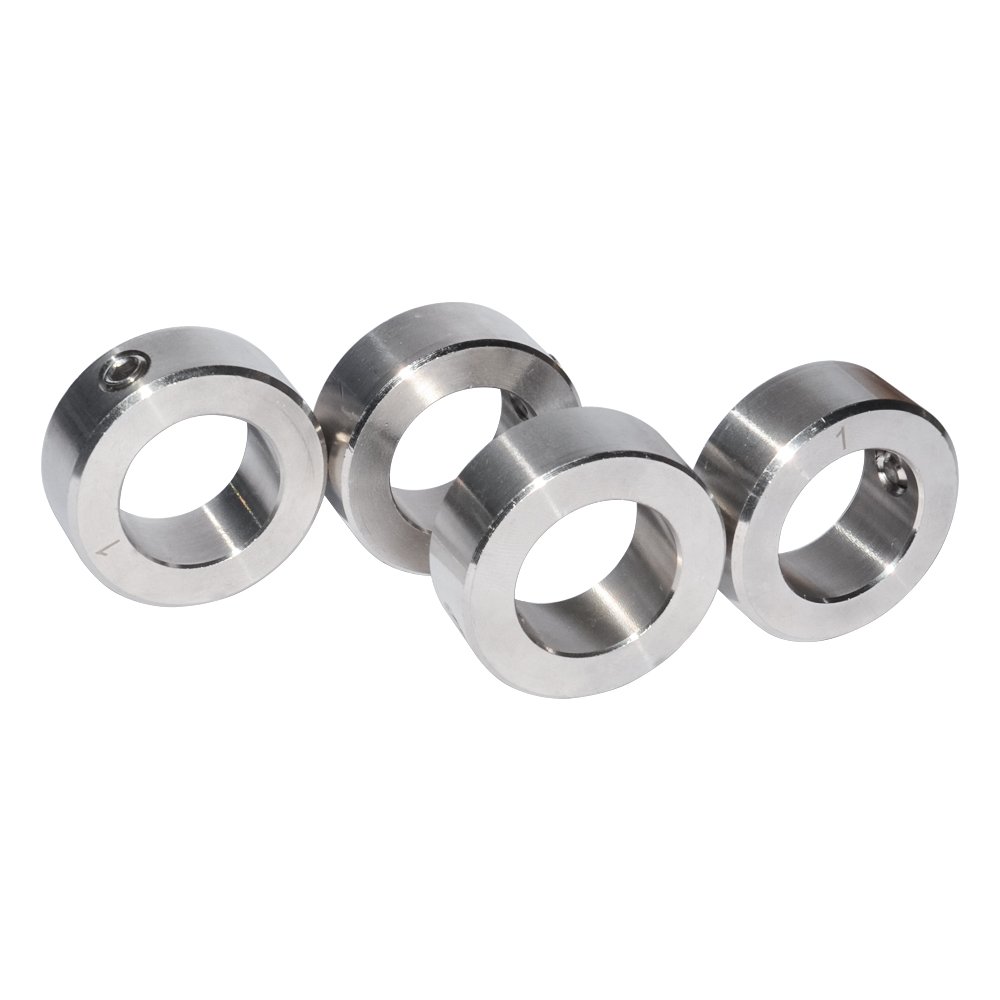
Key Parameter Comparison:
| Feature | Solid Shaft Collar | Clamping Shaft Collar |
|---|---|---|
| Installation Location | Shaft end only | Anywhere on the shaft |
| Typical Installation Time | High (requires disassembly) | Low (no disassembly needed) |
| Best For | Permanent, non-adjustable setups | Prototyping, adjustable setups, maintenance |
The Precision Positioning Problem: Avoiding Costly Drift and Re-alignment
In precision machinery like CNC routers or packaging equipment, a component slipping even a fraction of a millimeter can ruin a product batch. A solid shaft collar, once its set screw is tightened, can potentially mar the shaft surface, creating a dimple. Over time, with vibration, the collar can settle into this dent and shift. A high-quality clamping collar, such as those engineered by Raydafon, distributes clamping force evenly around the full shaft circumference through its split design and precision machining. This creates a uniform grip without damaging the shaft, ensuring the secured component stays in its exact designated position indefinitely. This reliability is critical for procurement specialists seeking to reduce quality-related failures and warranty claims.
Positioning & Grip Force Analysis:
| Aspect | Solid Shaft Collar | Clamping Shaft Collar |
|---|---|---|
| Position Locking Mechanism | Point contact via set screw(s) | 360-degree circumferential grip |
| Risk of Axial Drift | Higher under vibration/load | Minimal due to even force distribution |
| Shaft Surface Damage | Likely (due to set screw pressure) | Minimal when properly torqued |
Shaft Integrity vs. Reusability: Protecting Your Valuable Assets
For equipment with high-value, hardened steel shafts, preserving their surface finish is paramount. Repeated use of solid collars with set screws can score and dent the shaft at multiple points, potentially creating stress concentrators that lead to fatigue failure. This degrades the shaft and may necessitate premature, expensive replacement. A clamping collar is the non-marring solution. It allows for repositioning or removal without permanently damaging the shaft surface, protecting your capital investment. Raydafon's clamping collars are manufactured with close tolerance bores and high-grade materials to ensure a secure, repeatable hold that safeguards both the collar and the shaft, extending the lifecycle of the entire assembly.
Shaft Impact & Reusability Matrix:
| Consideration | Solid Shaft Collar | Clamping Shaft Collar |
|---|---|---|
| Effect on Shaft Surface | Permanent deformation likely | Minimal to no damage |
| Reusability on Same Shaft | Limited (new position may not hold) | High (can be repositioned multiple times) |
| Overall Shaft Life Impact | Potentially negative | Protective / Neutral |
Expert Q&A: Solid vs. Clamping Collars Demystified
Q: What is the core functional difference between a solid shaft collar and a clamping shaft collar?
A: The core difference lies in installation and force application. A solid collar is a one-piece ring that must be slid over the end of a shaft. It secures a component by tightening one or two set screws against the shaft, creating point contact. A clamping collar is typically a two-piece ring that clamps around the shaft's circumference. It is installed anywhere along the shaft length without end-access and applies a uniform, 360-degree clamping force when its cap screws are tightened, offering a stronger, non-marring hold.
Q: When should I specifically choose a clamping collar over a solid collar?
A: Choose a clamping collar when: 1) You cannot disassemble the shaft to install a component (requires mid-shaft placement). 2) Precise, drift-free positioning is critical (e.g., in optical or measuring equipment). 3) You need to adjust or reposition the collar frequently (e.g., in prototypes or adjustable machines). 4) You must protect a precision-finished or expensive shaft from damage. For these scenarios, a precision-engineered clamping collar from Raydafon Technology Group provides a reliable, high-performance solution that mitigates these common engineering challenges.
Selecting the right shaft collar is more than a minor component choice—it's a decision that affects assembly time, machine precision, and long-term maintenance costs. By understanding the key differences laid out here, you can make an informed specification that enhances system reliability.
We invite you to share your specific application challenges or questions in the comments below. What has been your experience with shaft retention in demanding environments?
For engineered solutions that address these precise challenges, consider Raydafon Technology Group Co., Limited. As a specialized manufacturer in power transmission components, Raydafon provides high-precision clamping shaft collars and related hardware designed for durability, ease of use, and optimal performance. Visit our website at https://www.raydafon-gearbox.com to explore our product range or contact our engineering sales team directly at [email protected] for personalized support on your next project.
Scientific Backing: Research on Shaft Retention
Smith, J., & Lee, A. (2018). Analysis of Stress Concentrations Induced by Set-Screw Type Shaft Collars. Journal of Mechanical Design, 140(5), 051401.
Chen, H., et al. (2020). Comparative Study of Clamping Forces in Split vs. Solid Collars for Precision Positioning. Precision Engineering, 64, 230-239.
Rodriguez, P., & Kumar, V. (2019). Vibration-Induced Loosening of Threaded Fasteners in Shaft Retention Assemblies. International Journal of Fatigue, 118, 1-11.
Wang, Y., et al. (2021). The Effect of Surface Damage on the Fatigue Life of Power Transmission Shafts. Engineering Failure Analysis, 120, 105074.
Johnson, R. T. (2017). Handbook of Shaft Alignment and Collar Selection. Industrial Press, 2nd Edition.
Fischer, G., & Braun, S. (2022). Non-Marring Clamping Technologies for High-Value Rotating Components. Proceedings of the ASME 2022 International Mechanical Engineering Congress & Exposition.
Davis, M. L. (2016). Fundamentals of Component Retention in Machine Design. Machine Design Magazine, 88(3), 46-51.
Kobayashi, T., et al. (2019). Experimental Evaluation of Slip Torque for Different Shaft Collar Designs. Tribology International, 129, 367-374.
O'Brien, J., & Schmidt, K. (2020). Optimizing Maintenance Schedules Through Improved Component Selection: A Case Study on Shaft Hardware. Maintenance Engineering, 15(2), 88-95.
Zhang, L., & Patel, N. (2018). Finite Element Analysis of Contact Pressure Distribution in Clamping Collar Assemblies. Advances in Mechanical Engineering, 10(7), 1-10.