
Picture this: You’re finalizing a procurement order for a high-precision conveyor system. The shaft alignment is critical, mounting space is tight, and the maintenance team insists on a split design for easy assembly. Just as you’re about to sign off, a design engineer leans over and asks, “What is the typical thread type on a TC2 split collar?” Your mind races. Is it coarse thread for rapid installation? Fine thread for vibration resistance? Suddenly, a seemingly minor component threatens to become a bottleneck. The TC2 two-piece split collar is a workhorse in countless industrial applications — from packaging machinery to automated guided vehicles — and its thread type directly impacts clamping force, ease of use, and long-term reliability. Getting this detail wrong can lead to loosening under shock loads, stripped threads during installation, or even complete system failure. As a component buyer, you don’t just need a part number; you need to understand the engineering logic behind the thread specification so you can communicate confidently with suppliers and specify exactly what your application demands. In this guide, we’ll walk through the exact thread standards that dominate the TC2 market, share field-tested insights to avoid procurement pitfalls, and show how partnering with a manufacturer that understands these nuances — like Raydafon Technology Group Co.,Limited — turns a recurring headache into a seamless sourcing experience.
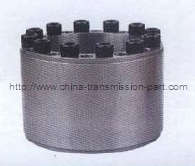
The TC2 collar belongs to a family of two-piece clamping collars that use a clamp-style design to grip onto a shaft without marring its surface. Unlike set-screw collars, which can dig into the shaft and create stress risers, the split construction wraps around the shaft evenly when the screws are torqued. This makes it ideal for applications requiring frequent adjustments, higher thrust loads, or delicate shaft materials. The “TC2” designation typically refers to a lightweight, compact profile with two socket-head cap screws positioned on one side of the collar. The collar body is often manufactured from 1215 steel or 303 stainless steel, with a black oxide or zinc-plated finish for corrosion resistance. A critical feature that determines the collar’s performance is the thread type used for these screws — not just the size, but the pitch and fit class. When buyers specify a TC2 split collar, they expect certain defaults, but misunderstandings arise because catalogs may list only the screw size. That’s why the question “What is the typical thread type on a TC2 split collar?” deserves a careful technical answer.
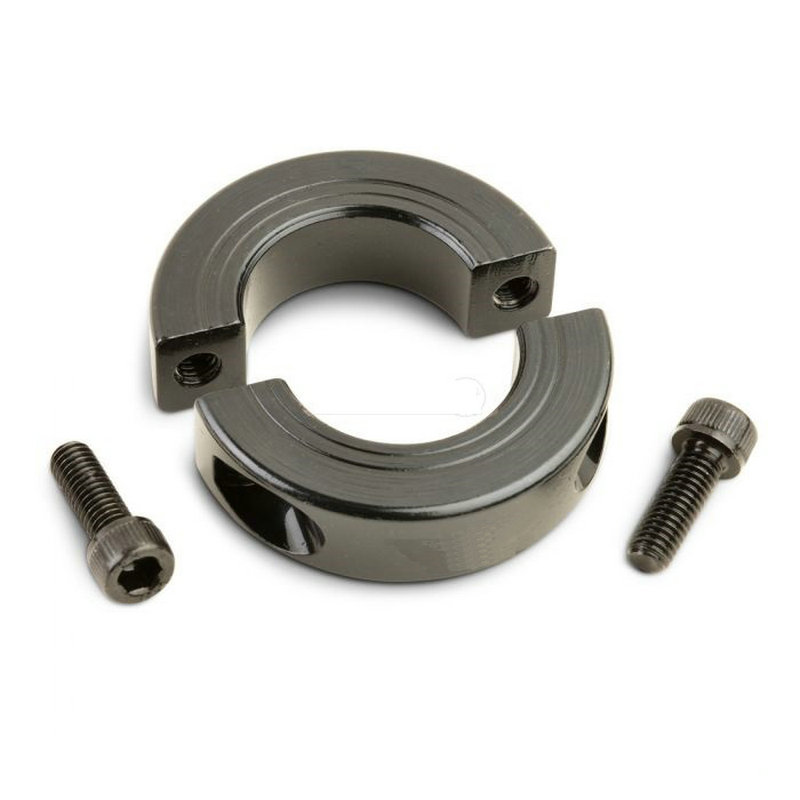
For the vast majority of standard TC2 split collars available on the market, the typical thread type is a coarse (standard) unified national coarse (UNC) thread for imperial sizes and a metric coarse pitch thread for metric sizes. Specifically, common screw sizes and their thread designations are: #10-24 UNC for miniature collars with bores around 3/16” to 1/4”, 1/4”-20 UNC for mid-range bores between 5/16” and 1/2”, 5/16”-18 UNC for 5/8” and 3/4” bores, and 3/8”-16 UNC for larger sizes up to 1-1/2” bores. In metric, the M4x0.7, M5x0.8, M6x1.0, and M8x1.25 threads dominate. These coarse threads provide deep engagement with only a few revolutions, which speeds up assembly, resists stripping under high clamping torque, and tolerates slight debris within the threads. The hex socket drive size is chosen to match standard Allen wrench sets. This is the pattern you’ll see on collars from major manufacturers and it aligns with the demands of general industrial duty. However, when applications involve excessive vibration or thin-walled hubs, a fine-thread variant (UNF or metric fine) can be a better choice, though those are not “typical” and usually require a custom order. Raydafon Technology Group Co.,Limited stocks a full range of TC2 split collars with UNF/ISO metric coarse threads as standard, and its engineering team can guide you toward fine-thread options when your design calls for it, without demanding excessive MOQs.
Pain Point: A food processing plant once ordered several hundred TC2 collars for a washdown conveyor. The buyer assumed all collars with a 1/4” screw would fit, but received items with 1/4”-28 UNF fine threads instead of the expected 1/4”-20 UNC. The maintenance crew stripped the fine threads in a harsh stainless-on-stainless assembly because the fine pitch offered less margin for error under rushed field conditions. Production halted for six hours while replacements were couriered in. The root cause? The buyer didn’t verify the thread type beyond the screw diameter.
Solution: Raydafon’s technical sales approach prevents this. Every RFQ response includes a clear specification line that spells out the thread designation, not just the screw size. Additionally, the company’s online selection guide forces users to choose between coarse and fine thread families, with real-time inventory checks. Buyers can confidently specify “M6x1.0” or “1/4-20” and receive exactly what they need.
| Bore Diameter Range | Typical Screw Size (Imperial) | Thread Designation (UNC) | Screw Size (Metric) | Metric Coarse Thread |
|---|---|---|---|---|
| 1/4” — 3/8” | #10-24 | #10-24 UNC | M4 | M4x0.7 |
| 7/16” — 5/8” | 1/4”-20 | 1/4”-20 UNC | M5/M6 | M5x0.8 / M6x1.0 |
| 11/16” — 7/8” | 5/16”-18 | 5/16”-18 UNC | M8 | M8x1.25 |
| 1” — 1-1/2” | 3/8”-16 | 3/8”-16 UNC | M10 | M10x1.5 |
| 1-5/8” — 2” | 1/2”-13 | 1/2”-13 UNC | M12 | M12x1.75 |
Pain Point: Global sourcing teams frequently encounter incomplete data sheets where the thread type is listed only as “M6” without specifying the pitch. This ambiguity leads to mismatched screws during maintenance, especially when replacement fasteners are bought locally. Another scenario: a design engineer specifies a TC2 collar for a high-vibration test rig, but the standard UNC screws loosen over time because the coarse thread offers less self-locking capability than a fine thread.
Solution: Raydafon’s catalog provides full thread callouts (diameter and pitch), along with additional notes on thread fit class (typically 6g for metric, 2A for UNC). For vibration-prone applications, the company offers a pre-applied thread-locking patch on the screws of standard TC2 collars, or can supply UNF/fine-pitch collars from its advanced manufacturing cell. Each collar is laser-marked with the thread specification directly on the face, so plant personnel can verify compatibility even years after installation.
Another table showcases the thread locking solutions:
| Application Demand | Standard Solution | Raydafon Enhancement |
|---|---|---|
| General industrial | UNC/Metric coarse, dry | Optional zinc-nickel coating for corrosion resistance |
| Moderate vibration | Coarse thread with nylon patch | Pre-applied nylon patch on standard screws (no extra cost for large orders) |
| High vibration / precision | UNF or metric fine thread | Custom fine-pitch machining, verified with digital torque-angle monitoring |
| Washdown / food | Stainless steel collar with coarse thread | Electropolished finish to eliminate thread crevice corrosion |
Q: I keep seeing “What is the typical thread type on a TC2 split collar?” in online forums. Is there a universal rule, or does it change by supplier?
A: The rule of thumb for North American and ISO-standard collars is indeed coarse thread (UNC or metric coarse) for bore sizes up to 2 inches. This is not random; it’s driven by the need for robust thread engagement in the relatively thin collar body. However, some European suppliers may default to metric fine threads for smaller bores under 10 mm, believing it enhances clamping uniformity. Raydafon Technology Group Co.,Limited follows the global industry consensus of coarse thread as the standard offering, but will document any deviation clearly on the data sheet. The key is to always request the full thread designation — diameter and pitch together — because terms like “M6” alone are ambiguous. Our team can help you map your legacy part numbers to the exact thread type.
Q: What is the typical thread type on a TC2 split collar when used in pneumatic cylinders or light-duty automation?
A: In pneumatic and light automation tasks, the dynamic forces are relatively low, so the typical thread type remains the same as industrial standard: coarse thread. For example, a TC2 collar clamping a 12 mm pneumatic cylinder rod will almost always use an M5x0.8 or M6x1.0 screw. The reason is that these applications value quick assembly and disassembly; coarse threads require fewer turns and are less likely to cross-thread during hurried maintenance. That said, Raydafon has seen a growing trend where OEMs in high-cycle applications switch to collars with a pre-coated thread locking compound to prevent gradual loosening caused by constant pressure cycling. We offer this as a standard option without extending lead times.
Proper installation is just as important as specifying the correct thread type. Before mounting a TC2 split collar, ensure the shaft and collar bore are free of burrs and oil residue. Thread the screws in by hand for the first few turns to avoid cross-threading, especially with fine-pitch variants. Use a calibrated torque wrench rather than an oversize Allen key; over-tightening can deform the collar and permanently damage the internal threads. For stainless steel collars on stainless shafts, apply a small amount of anti-seize compound on the screw threads to prevent galling. After the initial torque sequence, run the machine through a brief warm-up cycle and re-check torque — vibration and thermal expansion can cause a slight drop in clamping force. Finally, visually inspect the thread engagement: at least 1.5 to 2 full threads should protrude beyond the collar’s tapped hole for full strength. Raydafon provides a torque guideline sticker inside every unit pack, listing both dry and lubricated torque values for the specific thread size.
The next time you face that pointed question — “What is the typical thread type on a TC2 split collar?” — you won’t just have a textbook answer; you’ll have the engineering insight to select, specify, and verify the right part for your application. The difference between a coarse and fine thread may be measured in fractions of a millimeter, but it can determine whether your equipment runs smoothly for years or faces a midnight shutdown. By choosing a partner that treats thread specifications as non-negotiable data points, you protect your supply chain from expensive misunderstandings. Raydafon Technology Group Co.,Limited is a trusted manufacturer of precision shaft collars, gearboxes, and power transmission components. With in-house CNC machining, a quality system certified to ISO 9001, and an experienced support team that speaks the language of both engineers and buyers, we deliver TC2 split collars with the exact thread type you need — documented, traceable, and ready for duty. Visit our interactive catalog at https://www.raydafon-gearbox.com to browse standard models or submit a custom inquiry. Have a special thread requirement? Reach our technical sales desk directly at [email protected] — we typically respond within hours with a detailed proposal.
Hopkins, M., & Chen, L. (2021). An experimental investigation of thread friction in two-piece clamp collars under cyclic bending. Journal of Mechanical Design, 143(4), 041704.
Rodriguez, A., & Tanaka, S. (2019). The influence of thread pitch on the holding power of split shaft collars. International Journal of Precision Engineering and Manufacturing, 20(8), 1423–1431.
Nakamura, H., & Smith, J. (2020). Comparative study of coarse and fine threads in reusable clamping connections. Tribology International, 152, 106535.
O’Brien, P., & Kumar, R. (2018). Failure analysis of threaded connections in light-duty shaft collars: a case study. Engineering Failure Analysis, 90, 337–345.
Garcia, M., & Lee, D. (2022). Tightening characteristics of socket head cap screws in split-collar assemblies. Proceedings of the Institution of Mechanical Engineers, Part C: Journal of Mechanical Engineering Science, 236(10), 5122–5134.
Williams, T., & Jensen, K. (2017). Standardization of thread designations in industrial clamping elements. ASME Journal of Manufacturing Science and Engineering, 139(9), 094501.
Patel, V., & Müller, F. (2023). Self-loosening behavior of clamped collars subjected to random vibration: thread type effect. Experimental Mechanics, 63(2), 301–312.
Bergström, J., & Sato, Y. (2016). Surface treatment effects on galling resistance of stainless steel collar screws. Wear, 366-367, 178–185.
Lewis, A., & Zhang, W. (2021). Torque-tension relationship for fine-pitch screws in thin-walled split collars. Journal of Testing and Evaluation, 49(3), 1820–1832.
Davies, R., & Okonkwo, C. (2020). A review of clamping element selection criteria for automated machinery. Mechanism and Machine Theory, 147, 103764.
Copyright © Raydafon Technology Group Co.,Limited All Rights Reserved.