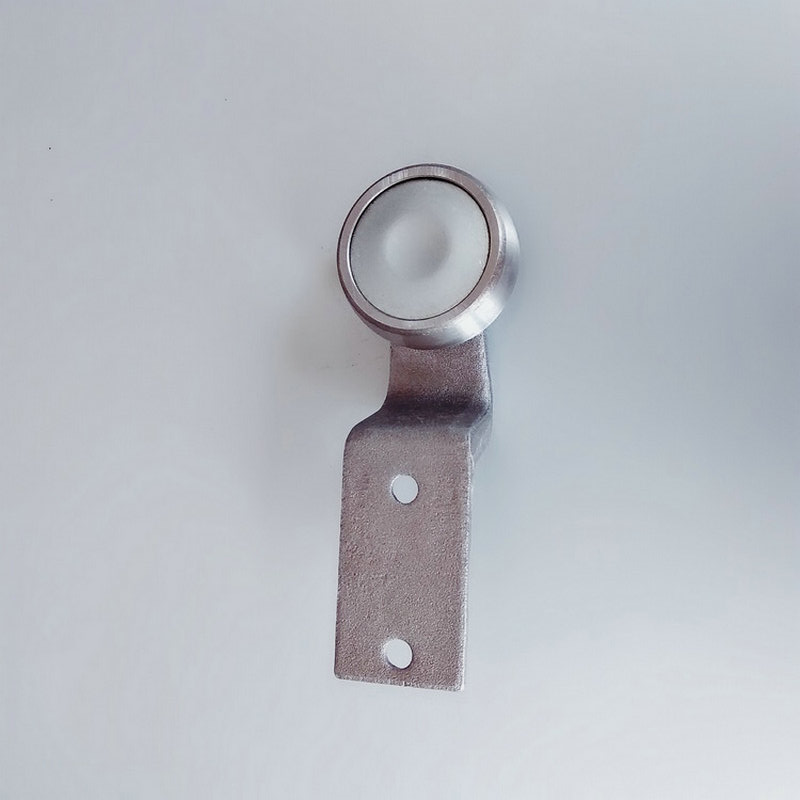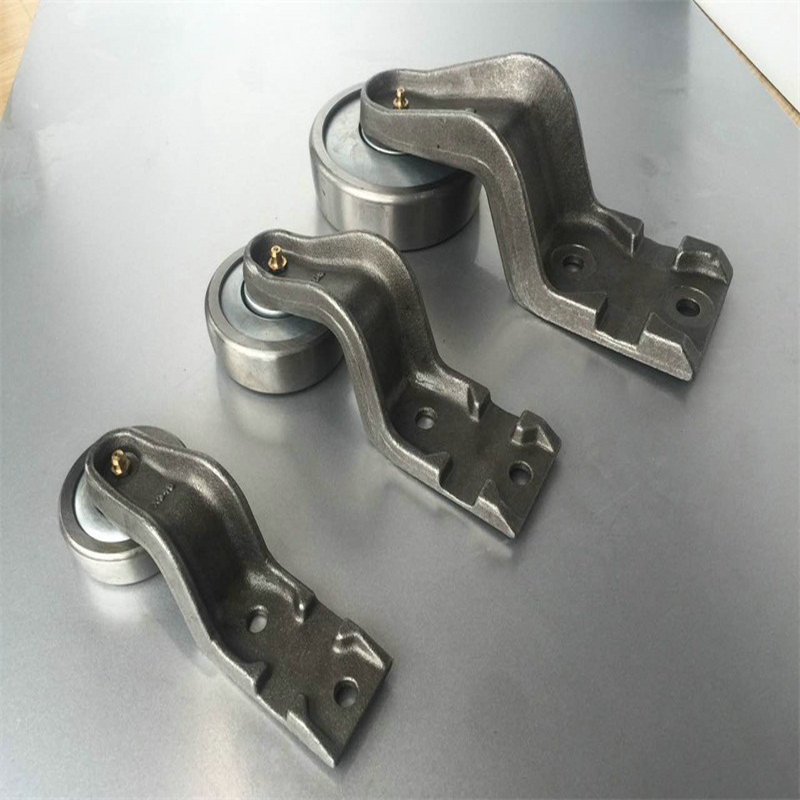

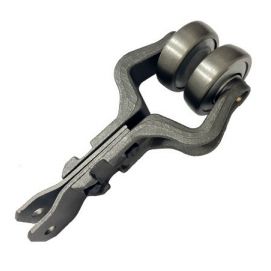

Raydafon manufactures heavy-duty suspension conveyor trolleys at our Ningbo plant for overhead conveyor integrators, automotive stamping lines, steel mills and large-warehouse logistics systems. Body built from high-strength alloy or quality carbon steel, welded and heat-treated to carry multi-ton and tens-of-ton payloads on an overhead track. Three stock series cover the common track gauges, with custom body length, wheel grade and load point available from drawing.
The three series share the same welded body architecture but differ in track gauge, wheel diameter and pin size. XT80 and XT100 use the same φ12 pin, so they are interchangeable on the same trolley attachment; XT160 steps up to a φ20 pin, which changes the hanger or yoke you need. Confirm pin diameter against your existing hangers before ordering a mixed batch.
| Model | A (mm) | B (mm) | C (mm) | D — Pin | E (mm) | Recommended Duty |
|---|---|---|---|---|---|---|
| XT80 | 63.5 | 100 | 16 | φ12 | 66 | Light-medium overhead conveying, small stampings, general assembly |
| XT100 | 82 | 131.1 | 20 | φ12 | 74 | Medium payloads, automotive sub-assembly, appliance lines |
| XT160 | 102 | 170.8 | 25 | φ20 | 109 | Heavy payloads, body frames, steel billets, large molds |
The A–E letters are the five numbers buyers need when replacing an existing trolley, but the letters alone don't tell you what they measure. The cards below map each letter to the physical feature on the trolley, so the drawing can be checked against the track and the hanger before the order is placed.
Four subassemblies carry the load on a suspension trolley, and each one fails in a different way when it is underspecified. The breakdown below is what our engineers check on every batch.
High-strength alloy or quality carbon steel, welded with internal stiffeners and heat-treated after welding. The stiffeners distribute the payload across the body so no single weld sees the full load. This is what allows the trolley to carry multi-ton and tens-of-ton payloads without distortion.
Wheel diameter grows with the series — 16 mm on XT80, 20 mm on XT100, 25 mm on XT160. Hardened tread rolls on the I-beam flange and carries the vertical load into the track. Wheel wear is the first thing to check during a maintenance window.
Bearing housing and pin are matched to the wheel size. A φ12 pin on XT80 / XT100 handles the load-point connection; XT160 steps up to φ20 for heavier hangers. Both pin and bearing are replaceable without cutting the body off the track.
The load point is machined to accept a standard hanger, yoke or sling, and the pin diameter decides which one fits. If your existing hangers are φ12, choose XT80 or XT100. If they are φ20, choose XT160 — do not mix pin sizes on the same line without changing the hangers.
Suspension trolleys are selected against two numbers: the payload the line actually carries, and the track gauge the trolley has to run on. The three applications below cover most of the heavy-duty trolley volume we ship.
Large machine beds, heavy shafts and castings moved between machining stations on an overhead line. XT100 and XT160 are the usual choices here, because the payload is heavy and the trolley has to hold position at each station without sagging.
Billets, coils and finished steel moved through steelmaking and rolling stages. XT160 with the φ20 pin is the standard here. Bodies are usually supplied without paint or with heat-resistant finish depending on the line temperature at the load point.
Sorting and moving large home appliances, industrial equipment and oversized cartons in a large warehouse. XT80 and XT100 cover most of this volume, with the trolley often paired with a spreader or take-up assembly on the same line.
Suspension trolleys are installed on a live conveyor, so a predictable fitting sequence matters as much as the part itself. This is the sequence we recommend to integrators, and the points our engineers will confirm before the order ships.
Confirm the I-beam flange width against the trolley wheel spacing before mounting. A trolley that binds on the flange will wear the wheel edge and lift the load point.
Match the hanger to the pin diameter — φ12 for XT80 and XT100, φ20 for XT160. Never force a φ20 hanger onto a φ12 pin; the result is a loose connection under load.
Engage the trolley with the conveyor chain drive dog and check chain tension with the take-up assembly. Incorrect tension is the most common cause of trolley bouncing on an overhead line.
Run the trolley through a full lap with no load, then with the design payload. Grease the bearing and pin at each scheduled maintenance window — both are replaceable without cutting the body off the track.
The three models share the same welded body architecture but differ in track gauge, wheel diameter, body height and load-point pin. XT80 is the light-medium series with a φ12 pin, XT100 is the medium series with a φ12 pin, and XT160 is the heavy series with a φ20 pin and a taller body. The pin diameter is the dimension that decides which hanger will fit.
A is the body length across the load point, B is the overall body width across the wheels, C is the wheel diameter, D is the load-point pin diameter, and E is the body height from the wheel centreline to the load-point centreline. When replacing an existing trolley, measure all five on the old part and confirm the pin diameter in particular — it decides which hangers will fit.
Yes. Drawing-based and sample-based production is core business. If you have no drawing, send the worn trolley as a sample and our engineers will measure it, reconstruct the A–E dimensions and confirm them back to you before production. Custom body length, wheel grade and load point are all producible.
High-strength alloy steel or quality carbon steel, welded with internal stiffeners and heat-treated after welding. The stiffeners distribute the payload across the body so no single weld sees the full load. Alternative grades are available where the line temperature at the load point requires a heat-resistant finish.
Carrying capacity depends on the model, the body material, the wheel grade and the track gauge it runs on, and can reach multi-ton or tens-of-ton payloads on the XT160 series. Capacity is confirmed per drawing against the application payload — send the load you carry and the track gauge and our engineers will confirm the correct model rather than rely on a generic catalogue figure.
Yes. Trolley, conveyor rail, conveyor line chain and take-up assembly are produced under one factory, so the track fit and chain engagement are confirmed against one drawing. Complete suspension line packages are quoted together. Lighter trolley variants are also available in the X348 and 698 series.
Sample lead time is typically 15 working days. Production lead time is 30–60 working days after the deposit, depending on model, quantity and whether the body is produced to a custom drawing. Payment terms are 30% T/T deposit with 70% before delivery; photos of the products and packaging are shared before the balance is paid. Dimensional report and material certificate available per shipment.
Include the model or the measured A–E dimensions, the load you carry, the track gauge your line runs on, and the quantity. Our engineers reply within one business day with a model recommendation, price and lead time.
Address
Luotuo Industrial Area, Zhenhai District, Ningbo City, China
Tel
Copyright © Raydafon Technology Group Co.,Limited All Rights Reserved.